LEADERSHIP DOMAIN · OPERATIONS & BUSINESS TRANSFORMATION

Building Businesses. Transforming Operations. Delivering at Scale.

Experience in building operating models, transforming complex operations, developing workforce ecosystems, redesigning commercial structures and scaling customer fulfilment across mobility and digital businesses.

200 Operating Kits Deployed
~400 Field Personnel Scaled
500+ Average Daily Appointments
2,000–3,000 Drivers in Delhi NCR
₹1,200 Daily Driver Subscription
30% North Fleet R&M Reduction
Core Leadership Framework

Operations Capability Blueprint

Transforming operating businesses requires synchronising frontline field realities with strategic commercial design, governance protocols, and scalable workforce incentives.

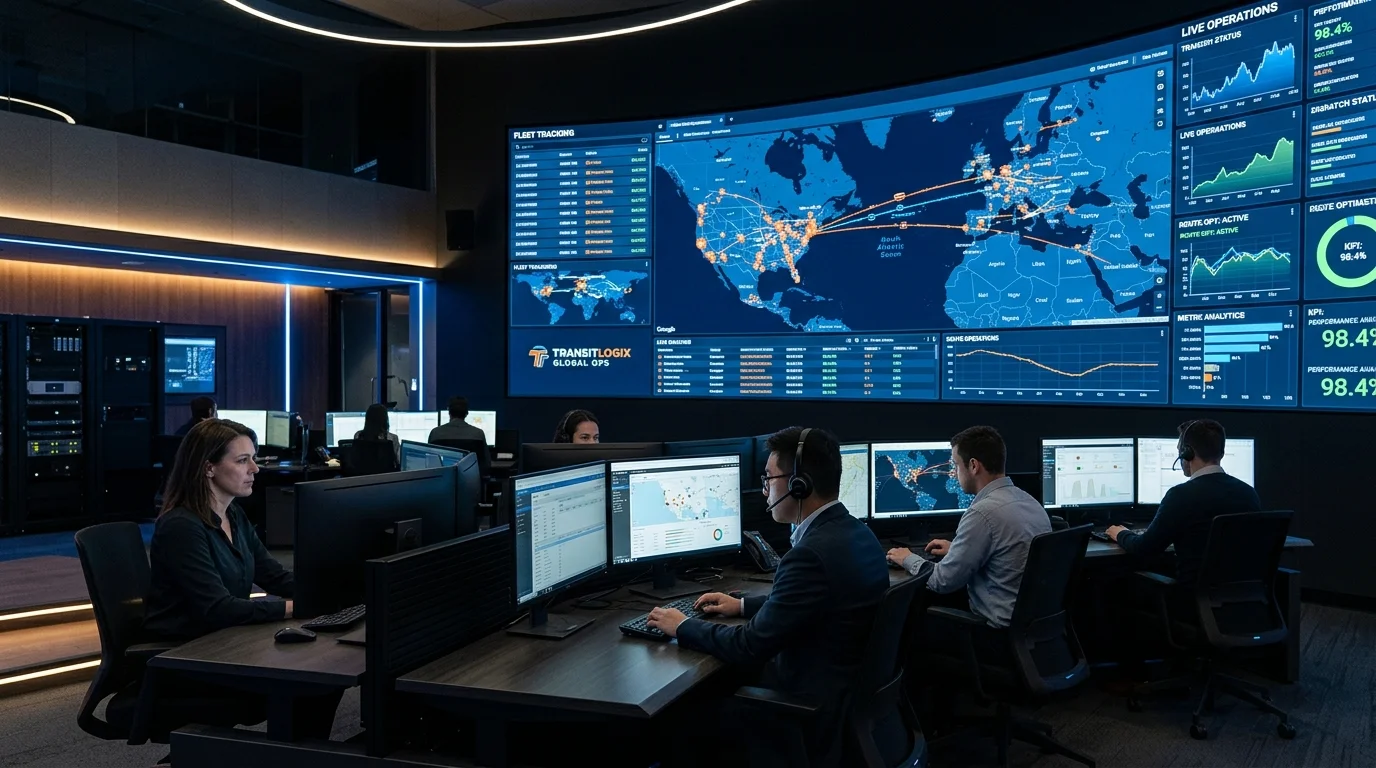
Executive operations command center showing fleet GPS telemetry and logistics analytics
01

Operating Model Design

Architecting unit economics, equipment kits, dispatch mechanisms, and frontline roles from zero to multi-city stability.

02

Process & Policy Codification

Aligning corporate advisory frameworks (such as KPMG standards) with frontline operational realities to produce practical, enforceable manuals.

03

Workforce Ecosystems

Transitioning fixed-salary employee operations into performance-driven, asset-light micro-entrepreneur networks that scale sustainably.

04

Business Model Transformation

Restructuring commercial architectures—such as converting bottleneck-prone prepaid airport services into high-throughput postpaid operations.

05

Last-Mile Customer Fulfilment

Orchestrating in-home consultations, technical appointments, and precision logistics while maintaining tight return-rate controls.

06

Multi-City Operations

Scaling standard operating procedures across tier-1 metropolitan clusters while adapting to municipal regulations and regional fleet conditions.

07

Commercial & Operational Integration

Harmonising billing systems, digital trip metering, airport authority clearances, and daily reconciliation flows into a single operating rhythm.

08

Scaling & Cost Optimisation

Executing fleet maintenance overhauls, rationalising vendor contracts, and reducing regional repair and maintenance costs by 30% through strict operational oversight.

In-Depth Case Studies

Executive Operational Case Records

Detailed examinations of business-building journeys, process overhauls, workforce restructuring, and measurable turnaround outcomes.

FEATURED CASE STUDY · OMNICHANNEL BUSINESS BUILDING

Building a Home Try-On Business and Transforming Its Operating Model

Lenskart · Project Head – Home Try-On · April 2014 – September 2015
2014–2015 · 7 Cities

Business Context: Lenskart was developing an assisted home eye-testing and eyewear sales model. The challenge was to build a scalable operating model that could deliver customer appointments, professional eye testing and product sales directly at customers' homes.

Mandate & Responsibilities: I led the team and was responsible for the conceptualisation and execution of the overall initiative. My mandate covered: conceptualisation and operating strategy, team leadership and hiring, deployment planning, operating kit design and distribution, workforce model, commercial and compensation structure, field operations, appointment fulfilment, and operational performance and business outcomes.

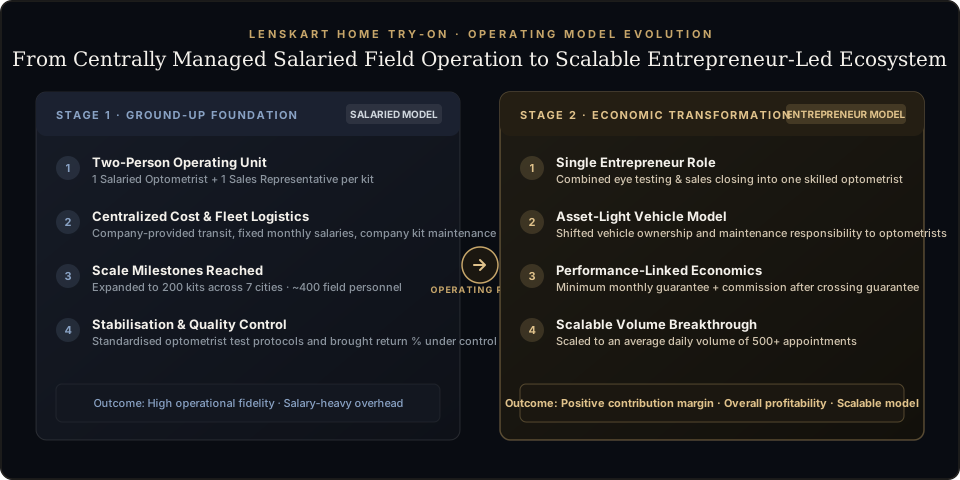
Lenskart Home Try-On optometrist conducting in-home eye examination and eyewear trial Lenskart Home Try-On Operating Model Evolution: Salaried Model vs Entrepreneur-Led Model
Figure 1: Illustrative in-home optical consultation setup and conceptual model comparison from salaried kits to an entrepreneur-led model.

Stage 1 — Building the Business from the Ground Up

The initial priority was establishing disciplined home appointments, professional clinical testing, and customer trust. The salaried operating foundation comprised:

  • Two-Person Operating Kits: Recruited and deployed paired operating units consisting of two people per kit: one salaried optometrist (carrying a clinical eye-testing retinoscope/autorefractor setup) and one salaried sales executive (managing trial frame inventory).
  • Seven Cities Deployed: Rapidly rolled out operations across seven major metropolitan hubs: Bengaluru, Pune, Chennai, Mumbai, Hyderabad, Kolkata, and Delhi NCR.
  • Scale Execution: Scaled the operation to 200 fully equipped operating kits across all seven cities, deploying approximately 400 field personnel.
  • Standardised Fulfilment & Return Control: Standardised home appointments, professional eye testing, product selection, and sales fulfilment, while establishing operational controls that brought return percentages under control.

Stage 2 — Pivoting to an Entrepreneur-Led Model

Once the operating model and service reliability were stabilized across all seven cities, the model evolved into an asset-light entrepreneur-led optometrist structure:

  • Independent Entrepreneurship: Optometrists moved towards independent entrepreneurship, operating using their own vehicles rather than centralized company logistics.
  • Combined Role Design: Combined clinical eye testing and consultative eyewear sales into a single role, rather than requiring two salaried people for every operating kit.
  • Minimum Guarantee & Commission: The compensation model included a minimum monthly guarantee, with sales commissions payable only after earnings crossed the minimum monthly guarantee, aligning workforce incentives with performance.
  • Scale & Profitability: The model scaled to an average daily volume of more than 500 appointments (rather than an isolated peak or target), achieving a positive contribution margin and overall profitability.
Operating Integrity Note

The entrepreneur-led model was deliberately introduced only after the 200-kit salaried operation was rigorously established and customer return rates were brought under control. This disciplined sequence ensured clinical quality and brand trust were preserved throughout commercial restructuring.
200 Kits Deployed across 7 Cities
~400 Staff Optometrists & Field Personnel
500+ / Day Average Daily Appointments
OPERATIONAL FOUNDATION · 5-YEAR LEADERSHIP JOURNEY

Building the Operational Foundation of Organised Radio Cabs in India

Meru Cabs · Role Progression: Manager – Quality to Head of Operations, Delhi · Nov 2007 – Oct 2012
2007–2012 · Delhi NCR & Pan-India

Five-Year Operational Leadership Journey: I joined Meru Cabs in November 2007 as Manager – Quality, initially responsible for designing organizational policies, operational workflows, and service quality processes. Once the foundational systems and processes stabilized, I gradually transitioned into operations leadership, ultimately leading city operations as Head of Operations, Delhi.

Workforce & Operating Responsibility: Headed the teams managing an operating organisation of approximately 1,500 employees and an active driver partner ecosystem of approximately 2,500–3,000 drivers across Delhi NCR. This involved comprehensive operational coordination across quality assurance, 24×7 dispatch control, driver management, fleet support, and field operations (driver partners operated within the business model, not as direct employees).

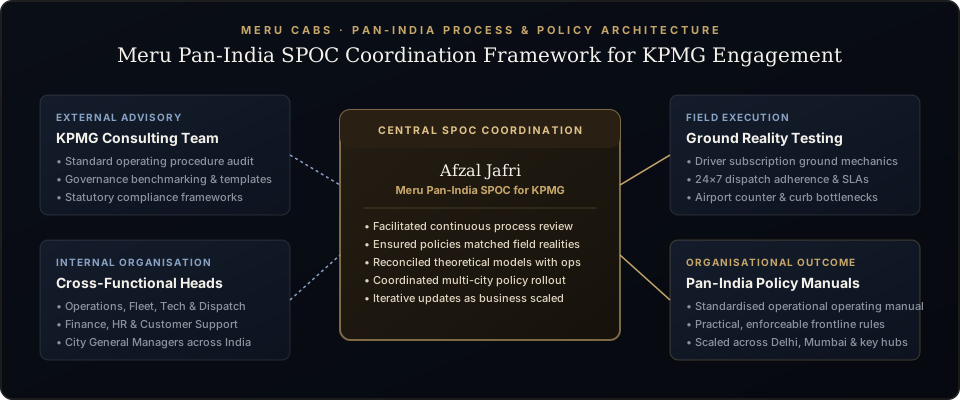
A. Pan-India Process & Policy Transformation (KPMG Engagement)

As Meru expanded its national operations, executive management engaged KPMG to formalise enterprise-wide operating policies. I served as Meru's Pan-India Single Point of Contact (SPOC) for the entire KPMG engagement:

  • Served as the central operational bridge and coordinator between KPMG consultants and internal department heads across all functional units (fleet, customer service, technology, finance, and human resources).
  • Gathered existing processes, reviewed and critically challenged proposed recommendations against frontline field realities, and refined policies to ensure they were practical to implement.
  • Supported enterprise-wide implementation and coordinated policy refinement as business requirements and operating conditions evolved.
Scope & Attribution Precision

I served as Meru's SPOC coordinating this extensive work. The policy transformation was a collaborative exercise involving internal department heads and KPMG consultants; it reflects joint governance and coordination rather than sole authorship of organizational policies.

Meru Cabs Pan-India Process and Policy Transformation Framework with KPMG
Figure 2: Illustrative Meru SPOC coordination framework reconciling KPMG governance standards with field realities.
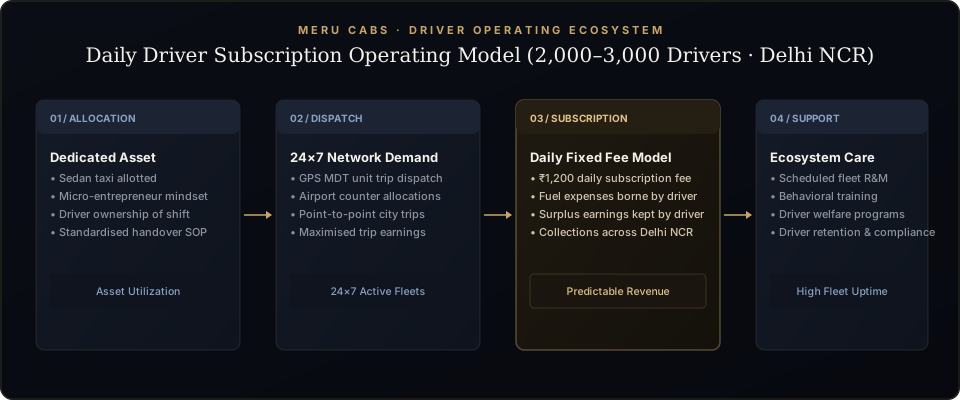
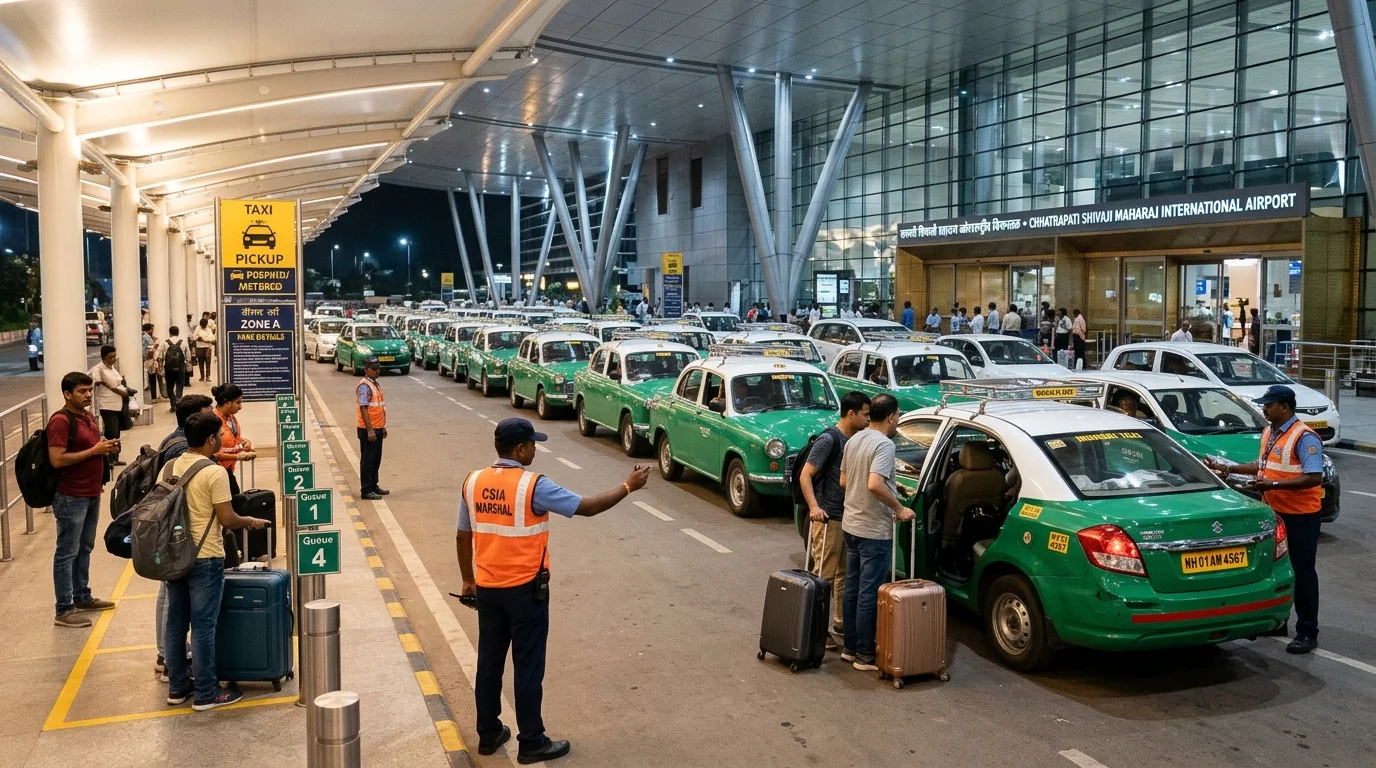
Airport taxi terminal curb operations and metered cab fleet boarding Meru Cabs Daily Driver Subscription Operating Ecosystem
Figure 3: Illustrative airport curb dispatch operations and daily driver subscription ecosystem covering 2,000–3,000 drivers in Delhi NCR.
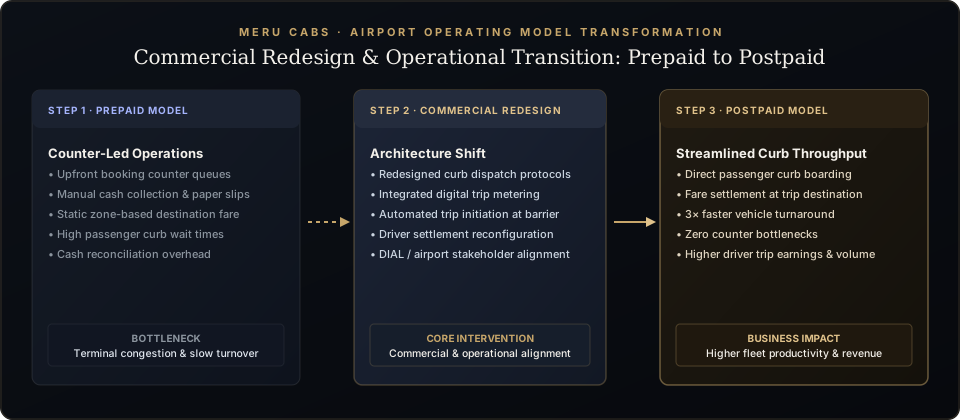
Meru Cabs Airport Mobility Transformation: Prepaid to Postpaid Model
Figure 4: Illustrative commercial redesign of airport terminal dispatch from prepaid to postpaid.

B. Driver Subscription & Entrepreneurial Ecosystem

Meru developed an operating model anchored in a daily driver subscription, establishing an entrepreneurial relationship with driver partners:

  • The operating ecosystem covered approximately 2,000–3,000 drivers in Delhi NCR only.
  • Drivers paid a fixed ₹1,200 per day as a daily subscription fee for the vehicle and automated dispatch business opportunity.
  • Meru's collections teams collected this subscription amount at designated locations across Delhi NCR.
  • Meru provided trip demand and customer bookings through an automated dispatch model.
  • Drivers were responsible for their own fuel expenses and retained all earnings above the daily ₹1,200 subscription amount.
  • Meru's operational teams managed the surrounding ecosystem: dispatch infrastructure, maintenance support, and driver compliance.

C. Airport Business Model Transformation (Prepaid to Postpaid)

Original Model: Arriving passengers originally booked prepaid journeys at designated airport counters. Meru had obtained the airport counter through a formal RFP process and operated under a revenue-share agreement with the airport operator (I did not independently obtain the counter or originate the commercial airport agreement).

Transformed Model: Led the operational implementation and rollout of the transition from prepaid counter bookings to direct curbside boarding and postpaid metered journeys:

  • Direct Curbside Boarding: Passengers walked directly to the curb to board taxis without queueing at terminal counters, with journeys metered and paid at the destination.
  • Operational Rollout: I led the operational implementation and coordination of the new arrangements, managing queue marshals, dispatch lanes, and ground staging protocols.
  • Throughput Impact: Terminal counter queues were eliminated, vehicle turnaround time was reduced by approximately 3×, and airport pickup throughput substantially increased as passenger pickups started earlier.
OPERATIONAL LEADERSHIP · NORTH INDIA BUSINESS HEAD

Operational Leadership, P&L Responsibility & Regional Governance

Meru Cabs · Deputy General Manager – North / Business Head · Feb 2017 – Mar 2018
2017–2018 · North India Region

Context of Return

Meru management rehired me in February 2017 because it wanted investors to have confidence in the people managing the business, including the leadership team. Having built the company's early operational foundations, I was entrusted with overall business leadership for the North region.

Mandate & Governance

I held direct P&L responsibility with authority over operational and commercial decisions across North India. My mandate encompassed fleet and maintenance performance, airport business operations, and corporate mobility accounts across the region.

Operational Deliverables & Regional Performance

Spearheading operational governance across fleet workshops, terminal operations, and B2B corporate mobility accounts:

  • Fleet & Maintenance Cost Reduction: Instituted strict preventative maintenance oversight, rationalised parts inventory, and audited vendor contracts, successfully reducing repair and maintenance (R&M) costs by 30% in the North region.
  • Airport Business Operations: Directed curbside staging, queue marshaling, and metered dispatch operations at Indira Gandhi International Airport (DIAL), maintaining high vehicle availability and service compliance.
  • Corporate Mobility Operations: Managed dedicated corporate fleet deployments, corporate client SLAs, and enterprise account service delivery across Delhi NCR.
  • Operational & Commercial Decision Authority: Governed regional pricing structures, branch cost controls, driver settlement discipline, and ground fleet compliance.
30% Reduction Fleet R&M Costs (North Region)
Direct P&L North India Business Leadership
Regional Authority Fleet, Airport & Corporate Mobility
HANDS-ON OPERATIONAL LEADERSHIP · MOBILITY AGGREGATION

Operational Leadership in an Early-Stage Mobility Aggregation Business

TaxiForSure · General Manager – Operations · Nov 2012 – Apr 2013
2012–2013 · Delhi NCR Branch

Led the Delhi NCR branch during an early-stage mobility aggregation growth phase, providing hands-on operational leadership across branch functions. Managed six direct senior managers across different branch departments, orchestrating daily field execution and customer service levels.

  • Driver Ecosystem & Shift Execution: Managed a branch driver network of approximately 200 drivers, with each driver operating seven duties, establishing disciplined shift scheduling and active vehicle availability.
  • Branch Operating Functions: Led comprehensive branch operating functions, including driver onboarding pipelines, vehicle and fleet quality inspections, dispatch execution, ride fulfilment, and service-level performance.
  • Service-Level Benchmarking: Instituted real-time duty tracking, vehicle compliance checks, and customer complaint resolution mechanisms that reinforced fulfilment consistency across the Delhi NCR market.
6 Managers Direct Senior Branch Leaders
~200 Drivers Delhi NCR Fleet Network
7 Duties Per Driver Operating Cycle
Frequently Asked Questions

Operations & Business Transformation FAQ

What was Afzal Jafri's role in building Lenskart's Home Try-On business?

As Project Head – Home Try-On, Afzal led the team and was responsible for the conceptualisation and execution of the overall initiative: first establishing a 200-kit salaried operating model (~400 field personnel) across seven cities and bringing return rates under control, then evolving the model into an asset-light, entrepreneur-led optometrist structure that scaled to an average daily volume of more than 500 appointments, achieving positive contribution margin and overall profitability.

What was Afzal's involvement in Meru Cabs' engagement with KPMG?

Afzal served as Meru's Pan-India Single Point of Contact (SPOC) for the engagement with KPMG. He coordinated between KPMG consultants and internal department heads across functions, gathering ground processes, challenging recommendations against operating realities, refining proposed policies, and supporting implementation to ensure SOPs reflected practical field conditions.

How was the Meru Cabs airport operating model transformed from prepaid to postpaid?

Passengers originally queued to book prepaid journeys at designated airport counters (obtained via RFP with airport revenue sharing). Afzal led the operational rollout and coordination of the transition to direct curbside boarding and postpaid metered journeys, eliminating counter queues, reducing vehicle turnaround time by approximately 3×, and accelerating airport passenger pickup throughput.

What were the achievements during Afzal Jafri's return to Meru Cabs as North Business Head in 2017?

Meru management rehired Afzal because it wanted investors to have confidence in the people managing the business, including the leadership team. Holding direct P&L responsibility and operational authority across North India, Afzal reduced fleet repair and maintenance (R&M) costs by 30% in the North region, while managing airport operations, corporate mobility accounts, and regional fleet performance.

How did the Meru Cabs driver subscription model operate?

The operating model covered approximately 2,000–3,000 drivers in Delhi NCR only. Drivers paid a daily subscription of ₹1,200, which Meru's collections teams collected across Delhi NCR. Meru provided the vehicle and business opportunities through an automated dispatch model; drivers bore their own fuel expenses and retained all earnings above the daily ₹1,200 subscription.

WhatsApp